
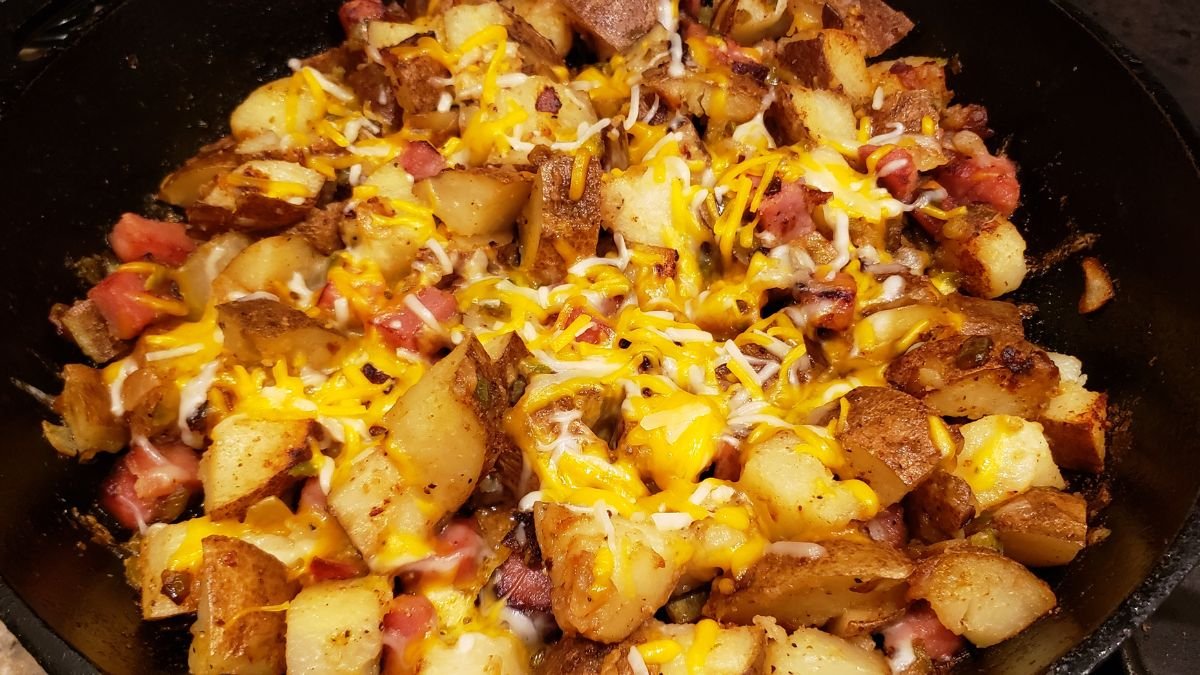

Ham and Cheddar Hash
Ingredients

Equipment
Method
- Preheat oven to 375°F.
- Wash and scrub the potatoes to remove any dirt and sand.
- Line a sheet pan with parchment paper.
- Poke a few holes in each potato with a fork and arrange on the pan.
- Bake for 1 hour and 15 minutes.
- Refrigerate until completely cold before dicing.
- Dice the cooled potatoes into 1/2 to 3/4 inch cubes.
- Heat a large cast iron skillet or griddle to 350°F.
- Spread avocado oil on the hot surface.
- Add the diced potatoes and sprinkle with salt and pepper.
- Sauté until lightly golden brown on all sides.
- Melt butter in a 12 or 15-inch cast iron skillet over medium-high heat.
- Add onions and peppers and sauté to desired doneness.
- Add the diced ham and cook until the edges start to brown.
- Add the diced potatoes and sauté until they crisp.
- Toss in the cheese and stir thoroughly until melted.
- Serve in the skillet with eggs and country white gravy on the side.
Notes
Tried this recipe?
Let us know how it was!Why This Recipe Works
This recipe came from teaching people how to use potatoes before they go bad on the shelf, or how to repurpose baked potatoes you didn't finish the night before. It's a practical lesson disguised as breakfast-nothing fancy, just proper technique applied to ingredients you already have. Restaurant kitchens never start hash from raw potatoes because it doesn't work. You either burn the outside trying to cook the center, or everything steams and turns to mush. The two-stage method-parcook first, crisp second-is how professionals guarantee golden, crispy hash every time. Learn this once, and you've got a reliable way to turn surplus potatoes into a breakfast people actually want to eat.
The Technique That Matters
The entire recipe hinges on separating the cooking into two distinct stages. First, you cook the potatoes through completely-boiling or roasting until tender but still holding their shape. Second, you finish them in a hot skillet with fat, building that golden crust while integrating the ham, peppers, onions, and cheese.
What You're Actually Doing
When you parcook potatoes, you're gelatinizing the interior starches without any browning. The inside becomes fluffy and fully cooked. Then, when those cooked potatoes hit high heat and butter in the skillet, the gelatinized starches on the surface crisp up beautifully. You're creating two textures in one potato cube-crispy outside, tender inside-which is impossible to achieve cooking from raw in a single pan.
Home cooks constantly try to do this in one step, tossing raw diced potatoes into a skillet and hoping for the best. What happens? The potatoes release moisture, steam themselves, and never develop a crust. Restaurants never work this way because it's unreliable. We always have parccooked potatoes ready to finish to order. The beauty of this method at home is that you can parcook the potatoes hours ahead, even the night before, which makes morning execution fast and foolproof.
Selecting and Preparing Potatoes
Russets are the correct choice for hash because their high starch content delivers fluffy interiors and crispy exteriors. Waxy potatoes like red or Yukon gold won't crisp the same way. You want uniform pieces that cook evenly and hold up to aggressive skillet heat.
What to Look For
- Freshness indicators: Firm potatoes with no soft spots, sprouting eyes, or green patches-green indicates solanine, which tastes bitter and shouldn't be eaten
- Size/uniformity: Medium to large russets that you can dice into consistent ½-inch to ¾-inch cubes-uniform size means everything finishes cooking at the same time
- Seasonal considerations: Russets are available year-round and store well, but this recipe is perfect for using up potatoes that have been sitting too long or repurposing leftover baked potatoes from dinner
Common Mistakes and How to Avoid Them
Most hash failures come from skipping the parcook step or using insufficient heat during the finishing stage. Here's what typically goes wrong and how to prevent it.
Problems and Solutions
- Problem: Potatoes are mushy and won't develop a crust → Solution: You didn't drain and dry them after parcoking, or you overcooked them in the first stage-pat them completely dry and stop parcoking when they're just fork-tender
- Problem: Everything sticks and burns → Solution: Your pan wasn't properly preheated or you didn't use enough fat-let the skillet get hot before adding butter, and don't skimp on it
- Problem: Vegetables are undercooked or ham is dried out → Solution: Add ingredients in stages-onions and peppers need time to soften before adding parccooked potatoes and ham, which only needs reheating
- Problem: Cheese turns greasy and separated → Solution: Add cheese at the very end off heat, letting residual warmth melt it gently instead of directly cooking it
Timing and Doneness
Parcoking takes 15-20 minutes depending on whether you boil or roast. The skillet finish takes another 10-12 minutes. You're looking for specific visual cues at each stage to know you're on track.
What Done Looks Like
Parccooked potatoes should be fork-tender but hold their shape when lifted-they shouldn't crumble or fall apart. In the skillet, you want deep golden-brown spots on multiple sides of each potato cube, with crispy edges and no pale, steamed-looking surfaces. The onions should be translucent and beginning to caramelize. The ham should have some color and toasted edges. The entire hash should smell nutty and caramelized, not bland or raw.
Variations and Serving Suggestions
Once you understand the two-stage technique, this hash becomes a template for using whatever you have on hand or whatever flavors you're craving.
Make It Your Own
- Seasoning variations: Add smoked paprika and cayenne for southwestern heat, fresh thyme or rosemary for herbaceous depth, or everything bagel seasoning for a breakfast twist
- Dietary modifications: Swap ham for turkey, chicken, breakfast sausage, or omit meat entirely; use ghee instead of butter for dairy-free; add mushrooms, zucchini, or tomatoes for more vegetables
- Serving ideas: Top with fried or poached eggs for a complete breakfast plate, serve with hot sauce and toast, or use as filling for breakfast burritos-perfect for weekend brunch or using up leftover ham and potatoes
Why It's Worth Making
Learning proper hash technique gives you a practical solution for potatoes that are about to turn or leftovers you don't want to waste. It's not about fancy ingredients-it's about understanding why restaurants parcook potatoes and applying that same logic at home. Once you've mastered this two-stage method, you'll use it for home fries, hash browns, and any breakfast potato situation. This is the kind of cooking that matters: taking something ordinary, applying proper technique, and turning it into breakfast that's worth making. No waste, no mystery, just potatoes cooked the right way.
Recipe
Ham and Cheddar Hash
Ingredients
Equipment
Method
- Preheat oven to 375°F.
- Wash and scrub the potatoes to remove any dirt and sand.
- Line a sheet pan with parchment paper.
- Poke a few holes in each potato with a fork and arrange on the pan.
- Bake for 1 hour and 15 minutes.
- Refrigerate until completely cold before dicing.
- Dice the cooled potatoes into ½ to ¾ inch cubes.
- Heat a large cast iron skillet or griddle to 350°F.
- Spread avocado oil on the hot surface.
- Add the diced potatoes and sprinkle with salt and pepper.
- Sauté until lightly golden brown on all sides.
- Melt butter in a 12 or 15-inch cast iron skillet over medium-high heat.
- Add onions and peppers and sauté to desired doneness.
- Add the diced ham and cook until the edges start to brown.
- Add the diced potatoes and sauté until they crisp.
- Toss in the cheese and stir thoroughly until melted.
- Serve in the skillet with eggs and country white gravy on the side.


Was this helpful?
You must be logged in to post a comment.