
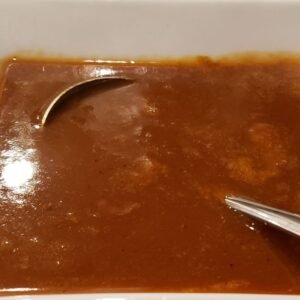
Turkey Gravy

Equipment
- Strainer
- Fat Separator
- 3-Quart Saucepan
- Whisk
- Gravy Boat
- Ladle
Ingredients
- 5 Tbsp Turkey Fat separated from roast turkey drippings
- 4 Tbsp All Purpose Flour
- 2 cup Turkey Drippings strained broth, separated from the fat
- 2 cup Chicken Stock low sodium
- 1 Tbsp Butter grass-fed, unsalted
- ¼ tsp Black Pepper ground

Instructions
- Strain the drippings from the roasted turkey.
- Use a fat separator to separate the turkey fat from the broth.
- In a 3-quart saucepan, heat the turkey fat over medium heat until all moisture has simmered out.
- Add the flour and whisk constantly for 4 minutes to cook the roux.
- Remove the pot from the heat.
- Add the chicken stock and turkey dripping broth all at once.
- Whisk quickly until the roux is completely dissolved into the liquid with no lumps.
- Return to heat.
- Bring to a low boil while whisking and cook for about 5 minutes until the gravy has thickened to your desired consistency.
- Add the butter and black pepper.
- Whisk one final time to melt the butter.
- Transfer to a gravy boat and serve immediately.
Notes
Why This Recipe Works
This is the real reason we all eat Thanksgiving dinner. It's for the gravy. Everything else on that table-the turkey, the stuffing, the mashed potatoes-they're all better because of what you're about to pour over them. But here's what most home cooks don't realize: gravy isn't complicated. It seems intimidating because it happens at the end when everyone's hungry and watching, but once you understand the components, it's one of the simplest things you'll make all day. Gravy is a thickening base plus flavorings plus liquid. That's it. Three components. You nail those three things, and you have great gravy. The thickening base is your roux-flour cooked in fat. Your flavorings come from the turkey drippings, already loaded with everything you seasoned the bird with. Your liquid is the pan juices or stock. Put them together properly, and you'll have gravy that's authentic, from-scratch, and can't be beat. Everyone will be talking about it.
The Technique That Matters
Everything comes down to building a proper roux. This is the foundation of your gravy, and it's the same technique professional kitchens use for every pan sauce, every cream sauce, every gravy that leaves the line. You're not taking shortcuts here-you're learning how flour and fat work together to create the silky, lump-free texture that separates great gravy from the gluey stuff people apologize for serving.
What You're Actually Doing
When you cook flour in fat, two critical things happen. First, you're coating every flour particle in fat, which prevents clumping when you add liquid later. Second, you're toasting the flour, developing nutty, complex flavors while cooking out that raw, pasty taste that ruins gravy. The turkey gives you delicious fat that's already flavored with everything you rubbed on that bird-herbs, salt, pepper, aromatics. Use that fat. Add your flour and make your roux, cooking it until it smells toasted and turns a light golden brown. This is your thickening base, and it needs to be right before you add anything else.
The ratio is simple: equal parts fat to flour by volume. You want a thick paste that bubbles gently as it cooks. Once your roux is ready-give it at least 3-4 minutes on medium heat-you add your liquid gradually. This is where home cooks panic and dump everything in at once, which creates lumps you can't whisk out. Add it in stages instead. The mixture will seize up and thicken dramatically when you add the first bit of liquid. That's supposed to happen. Keep whisking, and it will loosen as you add more. Then pour back in the juice or broth left over from the turkey cook, and season with any additional salt you might need or pepper. You'll have turkey gravy that is from scratch, authentic, and exactly what Thanksgiving dinner deserves.
Selecting and Preparing Flour and Drippings
The quality of your gravy depends on two things: clean fat for your roux and flavorful drippings for your liquid. When your turkey comes out of the roasting pan, you have a mixture of rendered fat, browned bits stuck to the pan, and liquid concentrated with turkey flavor.
What to Look For
- Separated fat: Use a fat separator or let drippings sit briefly so fat rises to the top-you need about 5 tablespoons of pure fat for the roux, supplemented with butter if necessary
- Strained drippings: Pour everything through a fine-mesh strainer to remove solids that would make your gravy gritty or burn in the pan
- All-purpose flour: Standard all-purpose flour works perfectly for gravy; no need for specialty flours that complicate the process
- Rich color: Your separated drippings should be deep brown and aromatic-if they're pale, your turkey didn't develop enough fond during roasting
Common Mistakes and How to Avoid Them
Gravy failures are almost always technique problems. You either rushed the roux, added liquid too fast, or didn't cook it long enough. Here's what goes wrong and how to fix it.
Problems and Solutions
- Problem: Lumpy gravy that won't smooth out → Solution: You added liquid too fast; whisk constantly and add gradually, or strain finished gravy through a fine-mesh strainer to remove lumps
- Problem: Gravy tastes pasty or floury → Solution: Your roux wasn't cooked long enough before adding liquid; always cook until it smells nutty and toasted, never rush this step
- Problem: Gravy too thin and watery → Solution: Either your roux ratio was off or it didn't cook properly; simmer longer to reduce, or make a small additional roux and whisk it in
- Problem: Gravy looks greasy or broken → Solution: Too much fat in proportion to flour; skim excess from the surface or whisk in small amounts of warm stock to re-emulsify
Timing and Doneness
Gravy is done when it coats the back of a spoon and holds a line when you drag your finger through it. This is nappe consistency in professional kitchens-the standard for properly thickened sauce that will cling to food without running off immediately.
What Done Looks Like
Your finished gravy should flow smoothly from a ladle but have enough body to coat turkey, mashed potatoes, and stuffing. It should be glossy and smooth, not matte or separated-looking. The color should be rich brown-deeper than the raw drippings but not dark like beef gravy. Taste it before you serve: you should get turkey flavor first, then the savory depth from the toasted roux, with no raw flour taste at all. If it seems too thick, whisk in additional warm stock a few tablespoons at a time. Remember that gravy thickens as it cools, so aim slightly thinner than your target consistency while it's hot.
Variations and Serving Suggestions
Once you understand the basic technique-roux plus liquid-you can adjust flavors to match your meal or experiment with different profiles.
Make It Your Own
- Herb additions: Whisk in fresh thyme, sage, or rosemary during the final simmer; strain before serving for smooth gravy with aromatic herb flavor
- Richer finish: Whisk in an additional tablespoon of butter off-heat for extra gloss and silky mouthfeel
- Giblet gravy: Simmer turkey neck and giblets in your stock, chop the cooked meat finely, and stir into finished gravy for traditional texture
- Make-ahead approach: Prepare gravy up to two days ahead; reheat gently, whisking in warm stock to restore consistency if needed
- Beyond turkey: Use this gravy over mashed potatoes, stuffing, biscuits, or roasted vegetables-it elevates everything it touches
Why It's Worth Making
When you learn how to build components, things that seem difficult or intimidating become straightforward. Gravy is your proof of that. You're not following a recipe blindly-you're understanding how fat, flour, and liquid work together to create sauce. Once you've got that down, you can make pan gravy from any roasted meat, cream sauce for pasta, or sausage gravy for biscuits without second-guessing yourself. But there's something particularly satisfying about nailing Thanksgiving gravy, that moment when you taste it and know it's exactly right. No lumps, no stress, no backup jar hidden in the pantry. Just smooth, rich, authentic gravy that makes everyone at the table ask for seconds. That's the confidence that comes from understanding technique, not just reading steps.
Recipe
Turkey Gravy
Equipment
- Strainer
- Fat Separator
- 3-Quart Saucepan
- Whisk
- Gravy Boat
- Ladle
Ingredients
- 5 tablespoon Turkey Fat separated from roast turkey drippings
- 4 tablespoon All Purpose Flour
- 2 cup Turkey Drippings strained broth, separated from the fat
- 2 cup Chicken Stock low sodium
- 1 tablespoon Butter grass-fed, unsalted
- ¼ teaspoon Black Pepper ground
Instructions
- Strain the drippings from the roasted turkey.
- Use a fat separator to separate the turkey fat from the broth.
- In a 3-quart saucepan, heat the turkey fat over medium heat until all moisture has simmered out.
- Add the flour and whisk constantly for 4 minutes to cook the roux.
- Remove the pot from the heat.
- Add the chicken stock and turkey dripping broth all at once.
- Whisk quickly until the roux is completely dissolved into the liquid with no lumps.
- Return to heat.
- Bring to a low boil while whisking and cook for about 5 minutes until the gravy has thickened to your desired consistency.
- Add the butter and black pepper.
- Whisk one final time to melt the butter.
- Transfer to a gravy boat and serve immediately.

Was this helpful?
You must be logged in to post a comment.