
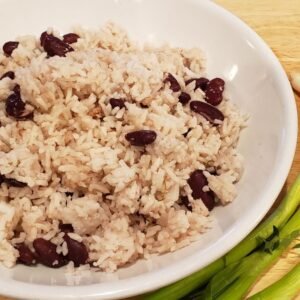
Jamaican Rice and Peas

Equipment
- Large Pot
- Colander
- Fork
Ingredients
Beans
- ½ lb Red Kidney Beans dried
- 6 cups Water for boiling beans
Rice and Peas
- 1 can Coconut Milk 15 oz
- 2 ¾ cups Bean Cooking Water reserved from boiling the beans
- 1 lb White Rice long grain
- 2 whole Scotch Bonnet Peppers whole, do not cut or break them
- 4 whole Green Onions cleaned, whole
- 8 sprigs Thyme fresh
- 2 tsp Kosher Salt Morton brand

Instructions
Prep
- Soak the dried kidney beans in water overnight.
- Drain and rinse the beans.
- Place beans in a pot with 6 cups fresh water and boil until tender, about 45 minutes to 1 hour.
- Reserve 2 3/4 cups of the cooking water.
- Drain the beans and set aside.
- Rinse the rice until the water runs clear.
Cook
- Combine the coconut milk, reserved bean cooking water, cooked beans, whole green onions, thyme sprigs, and kosher salt in a large pot.
- Bring to a boil.
- Add the rice and stir gently to combine.
- Place the 2 whole Scotch bonnet peppers on top of the rice.
- Cover the pot and reduce heat to low.
- Simmer for 20-25 minutes until the rice is tender and the liquid is absorbed.
Rest and Serve
- Turn off the heat and let the rice sit covered for 5 minutes.
- Remove the Scotch bonnet peppers, thyme sprigs, and green onions.
- Fluff the rice with a fork and serve.
Notes
Why Batch Jamaican Rice and Peas
It's Tuesday at 6 PM. You're home from work, you're tired, and you've got protein to cook but nothing to serve it with. Plain rice sounds boring. Takeout sounds expensive. Then you remember: three weeks ago, you spent 90 minutes making authentic Jamaican rice and peas, and there are four vacuum-sealed portions in your freezer. You pull one out, reheat it in 15 minutes while your chicken grills, and suddenly you're eating better than most Caribbean restaurants serve. This is the Tuesday night scenario that makes batch cooking worth every minute.
This dish shows up at every gathering in my extended family-different households, same traditions. While the kidney bean version is what most people know, I'm partial to the gungo peas variation (which you should absolutely try next). But regardless of which peas you use, the principle stays the same: this is foundational Caribbean cooking that deserves proper attention, which means batching it when you have time rather than rushing it on a weeknight.
The Restaurant Method
Professional Caribbean kitchens don't make rice and peas to order during dinner rush. They batch cook it properly-slowly simmering dried kidney beans until tender, building layers of flavor with whole scotch bonnets and fresh thyme, then cooking rice in that seasoned bean liquid enriched with coconut milk. The result gets portioned, held properly, and reheated to order. You're doing the same thing, except your holding method is vacuum sealing and freezing instead of a steam table.
What Makes This Worth the Time
Rice and peas is deceptively simple but has specific technique requirements. The beans need proper cooking to develop creaminess without turning mushy. The aromatics need to infuse the cooking liquid without overpowering the final dish. The rice needs to absorb that coconut-bean mixture perfectly-too wet and it's porridge, too dry and it's bland. When you batch cook, you give each step the attention it deserves, something that's impossible when you're rushing dinner at 7 PM on a Wednesday. You're also capturing authentic flavor that's nearly impossible to find in prepared foods. Most grocery store "Caribbean rice" uses canned beans and shortcuts the seasoning. Yours starts with dried beans you cook yourself, whole scotch bonnets, and fresh thyme. It's not even close to the same product.
Time Investment & Meal Yield
Here's the honest math on what you're building when you commit to this batch:
What You're Actually Building
- Active prep: 20 minutes hands-on (rinsing beans, prepping aromatics, measuring rice and coconut milk)
- Passive cooking: 60-70 minutes total (beans simmer 30-40 minutes, rice cooks 25-30 minutes-you're doing other things)
- Portioning & sealing: 10 minutes (divide into portions, vacuum seal, label with date)
- Result: 8-9 generous portions = 8-9 complete dinner sides over the next 6-8 weeks
The Real-World Timeline
You cook this once on a Sunday afternoon in late January. By mid-March, you've reheated it eight times alongside jerk chicken, grilled fish, curry goat, and brown stew pork. Each time took 15 minutes and tasted like you'd spent an hour building layers of flavor from scratch. That's the value proposition-90 minutes of work distributed across two months of dinners. The effort-to-benefit ratio is absurd, especially when you're pulling restaurant-quality Caribbean sides from your freezer while your neighbors are ordering $40 delivery.
Storage & The Freezer Reality
Let's address the concern directly: "Won't rice get weird after freezing?" Not if you handle it properly. Vacuum sealing is the game-changer here. It removes air, prevents ice crystal formation, and preserves texture in ways that plastic containers or zipper bags never will. This is professional food storage technique adapted for home use.
Why Vacuum Sealing Changes Everything
- Flat storage: Sealed bags stack efficiently in your freezer, no wasted space or freezer Tetris
- Fast thawing: Overnight in the fridge, or quick reheat same night in simmering water or microwave
- Zero freezer burn: 3-4 month freezer life, tastes fresh when reheated with no texture degradation
- Professional standard: How restaurants store prepared rice, beans, and grains between prep and service
The Commercial Food Comparison
Those frozen rice packets at the grocery store? They were manufactured weeks ago, sat in a distributor's freezer for more weeks, then lived in the grocer's freezer before landing in yours. The packaging expects them to sit in your freezer for 6-12 months. Your batch of rice and peas will be consumed within 6-8 weeks, making it dramatically fresher than anything labeled "fresh frozen" at the store. You're also using better ingredients-real coconut milk, dried kidney beans you cooked yourself, fresh aromatics instead of dried seasonings. The quality comparison isn't even fair.
Cost Breakdown
The economics of batch cooking rice and peas are compelling, especially compared to restaurant pricing or pre-made sides. Here's the real math using bulk purchasing:
Batch Cost Calculation
Ingredients breakdown:
- Dried red kidney beans: 0.5 lb × $1.50/lb = $0.75
- Long grain white rice: 1 lb × $1.50/lb = $1.50
- Coconut milk (15 oz can): $2.00
- Scotch bonnet peppers, green onions, fresh thyme, salt: $3.00
- Total batch cost: $7.25
- Portions created: 9 generous portions
- Cost per portion: $7.25 ÷ 9 = $0.81 per portion
The Savings Add Up
Per-meal comparison:
- Homemade portion: $0.81
- Restaurant rice and peas side: $5.50 average
- Savings per meal: $5.50 - $0.81 = $4.69
- Total batch savings: $4.69 × 9 portions = $42.21 saved over eating out
But the real value isn't just money-it's the Tuesday night convenience of pulling restaurant-quality Caribbean food from your freezer instead of ordering delivery or settling for plain white rice. That mental relief and time savings are worth more than the $42 you're pocketing.
Using This Component
Here's how vacuum-sealed rice and peas becomes actual dinners throughout your week:
Quick Assembly Meals
- Jerk Chicken Plate: Thaw overnight, reheat in microwave 4-5 minutes while chicken grills. Authentic Caribbean dinner in 20 minutes total.
- Curry Goat Bowl: Quick stovetop reheat in a covered pan with splash of water. Add braised goat, complete island meal in 15 minutes.
- Grilled Fish Dinner: Reheat sealed bag in simmering water for 10 minutes, snip open and serve alongside your protein. Restaurant plating at home.
- Brown Stew Pork Plate: Microwave portion while you reheat your protein, add quick cabbage slaw on the side. Balanced Caribbean dinner solved in 20 minutes.
This is how you stock a professional kitchen at home. You're not meal prepping in the obsessive Sunday-container sense-you're building infrastructure. Cook dried beans and rice once, season them properly with scotch bonnet and thyme, vacuum seal the results, and suddenly you've got authentic Caribbean sides waiting whenever you need them. Your freezer becomes a walk-in cooler. Your Tuesday nights become manageable. And you eat better food than you can buy anywhere for under $6 a portion. That's the entire point of batch cooking.
Recipe
Jamaican Rice and Peas
Equipment
- Large Pot
- Colander
- Fork
Ingredients
Beans
- ½ lb Red Kidney Beans dried
- 6 cups Water for boiling beans
Rice and Peas
- 1 can Coconut Milk 15 oz
- 2 ¾ cups Bean Cooking Water reserved from boiling the beans
- 1 lb White Rice long grain
- 2 whole Scotch Bonnet Peppers whole, do not cut or break them
- 4 whole Green Onions cleaned, whole
- 8 sprigs Thyme fresh
- 2 teaspoon Kosher Salt Morton brand
Instructions
Prep
- Soak the dried kidney beans in water overnight.
- Drain and rinse the beans.
- Place beans in a pot with 6 cups fresh water and boil until tender, about 45 minutes to 1 hour.
- Reserve 2 ¾ cups of the cooking water.
- Drain the beans and set aside.
- Rinse the rice until the water runs clear.
Cook
- Combine the coconut milk, reserved bean cooking water, cooked beans, whole green onions, thyme sprigs, and kosher salt in a large pot.
- Bring to a boil.
- Add the rice and stir gently to combine.
- Place the 2 whole Scotch bonnet peppers on top of the rice.
- Cover the pot and reduce heat to low.
- Simmer for 20-25 minutes until the rice is tender and the liquid is absorbed.
Rest and Serve
- Turn off the heat and let the rice sit covered for 5 minutes.
- Remove the Scotch bonnet peppers, thyme sprigs, and green onions.
- Fluff the rice with a fork and serve.
Was this helpful?
You must be logged in to post a comment.