
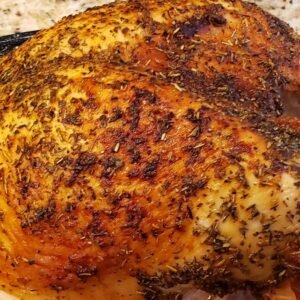
Herb Roasted Turkey Breast

Equipment
- Sheet Pan
- Bowl
- Roasting pan
- Wire Rack
- Aluminum foil
- Small bowl
- Probe thermometer
- Oven
Ingredients
Dry Brine
- 2 Tbsp Kosher Salt Morton brand
- 1 Tbsp Brown Sugar dark
- 1 tsp Black Pepper coarse ground
- 1 tsp Garlic Powder
- ½ tsp Onion Powder
- ½ tsp Smoked Paprika
Turkey Breast
- 1 Turkey Breast bone-in, 8-12 lb, fresh or frozen
Aromatics
- 1 Apple quartered
- 1 Onion quartered
- 2 sprigs Rosemary fresh
- 2 sprigs Thyme fresh
- 2 sprigs Sage fresh
- 1 stick Cinnamon

Instructions
Prep
- Place frozen turkey breast in a bowl or sheet pan on the bottom shelf of the refrigerator to thaw at least 5 days before your meal.
- Combine kosher salt, brown sugar, black pepper, garlic powder, onion powder, and smoked paprika in a small bowl.
- Remove wrapping from the turkey breast and pat completely dry with paper towels.
- Apply about 60% of the dry brine under the skin directly on the meat, and 40% over the skin.
- Place the turkey breast on a wire rack over a sheet pan.
- Refrigerate uncovered for 24-48 hours.
- Remove the turkey breast from the refrigerator about 2 hours before cooking to take the chill off.
- Roughly slice the apple and onion and place them in the breast cavity along with the fresh rosemary, thyme, sage, and cinnamon stick.
Roast
- Preheat oven to 500°F.
- Insert a probe thermometer into the thickest part of the breast from the neck end, going under the skin.
- Place the turkey breast in the center of the oven for 15 minutes.
- Reduce temperature to 350°F.
- Cook for 15-18 minutes per pound.
- For crispy skin, cook to 165°F internal and do not tent when you remove it from the oven.
- For moist meat, pull at 155-160°F, tent with foil immediately, and rest for 15-20 minutes until temperature reaches 165°F.
Rest and Serve
- Carve and serve.
- Save the drippings for turkey gravy.
Notes
Why Batch Turkey Breast
It's Tuesday night. You're exhausted, staring into your refrigerator, mentally calculating how long it would take to roast a turkey breast from scratch-ninety minutes minimum, plus overnight brining you definitely don't have time for. Then you remember: you have vacuum-sealed turkey portions in the freezer from that Sunday session three weeks ago. Twenty minutes later, you're plating sliced turkey with wild rice and green beans. That's the infrastructure play. You're not making turkey because it's Tuesday; you made it weeks ago when you had time, and now you're simply reheating professional-quality protein while your sides cook.
Turkey breast is the move when you're feeding a crowd and want more white meat, or when you're cooking for people who simply don't like dark meat. If you're doing Thanksgiving for a larger group than one whole bird will serve, you can roast a turkey plus a turkey breast-giving you more of the meat most people actually want instead of leftover dark meat that sits in the fridge untouched. Depending on your crowd size, you might go one turkey to two turkey breasts and solve the white meat shortage forever. But if you just prefer white meat year-round, this standalone batch component gives you restaurant-ready turkey breast whenever you need it, not just in November.
The Restaurant Method
Commercial kitchens don't brine turkey breast in giant containers of liquid taking up half the walk-in cooler. They use dry brines-salt, sugar, and spices rubbed directly onto the meat, left uncovered in the cooler overnight. The salt pulls moisture to the surface, dissolves, then gets reabsorbed with the seasonings. You get deep flavor penetration and juicy meat without dedicating half your refrigerator to a bucket of brine. It's the same technique used in professional prep kitchens because it's efficient, effective, and doesn't require specialized equipment.
What Makes This Worth the Time
Turkey breast benefits from batch cooking because it's one of those proteins that actually improves with gentle reheating. The dry brine seasons throughout, so every slice tastes complete-not like plain chicken breast that needs sauce to carry it. Bone-in breast stays moist during the long roast and through freezer storage, and the bone adds flavor during cooking. You're building a protein that works hot, cold, sliced thin for sandwiches, or cubed into salads. The aromatics-apple, onion, herbs, cinnamon stick-create a flavor base that makes this taste like Thanksgiving dinner, not generic deli turkey from the grocery store heat lamp.
And here's the efficiency play: one 10-pound turkey breast yields roughly 7 pounds of cooked meat, which portions into 14 servings of 8 ounces each. You're spending two hours total-30 minutes active work, 90 minutes passive roasting while you do laundry or watch TV-to solve three weeks of protein decisions. Compare that to stopping at the grocery store deli counter every few days, spending $10-12 per pound for pre-sliced turkey that's been sitting under heat lamps for who knows how long.
Time Investment & Meal Yield
Here's the honest math on what you're building with this batch component.
What You're Actually Building
- Active prep: 30 minutes hands-on (mixing dry brine, applying to turkey breast, prepping aromatics for roasting pan)
- Dry brining: 12-24 hours in refrigerator, uncovered (you're sleeping, working, living your life-zero active time)
- Passive roasting: 90-120 minutes in oven at 325°F (you're doing other things, not standing over the stove)
- Portioning & sealing: 20 minutes (slicing meat, vacuum sealing into portions, labeling with dates)
- Result: 14 portions of 8 ounces each = 3-4 weeks of dinners for two people, or 6-8 weeks of lunch protein
The Real-World Timeline
You'll pull these portions over the next month or two-Tuesday turkey and wild rice bowls with roasted Brussels sprouts, Thursday turkey sandwiches with cranberry mayo on sourdough, Sunday turkey salad with apples and candied walnuts over mixed greens. Each time, it's 15-20 minutes from freezer to table. The time investment disappears when you spread it across fourteen meals. You're trading one Sunday afternoon for a dozen Tuesday nights when you're too tired to cook from scratch or make yet another decision about what's for dinner.
Storage & The Freezer Reality
Let's address the concern everyone has: "But it's been frozen for six weeks-is it still good?" Yes. Emphatically yes. Here's the reality check you need to hear.
Why Vacuum Sealing Changes Everything
- Flat storage: Vacuum-sealed portions stack like files in a drawer-no freezer Tetris, no avalanche of bags when you open the door
- Fast thawing: Thin, flat portions thaw overnight in the fridge, or reheat from frozen in a 350°F oven in 20-25 minutes
- Zero freezer burn: No air contact means no ice crystals, no dried-out edges-3-6 month freezer life with quality that matches day-one freshness
- Professional standard: This is exactly how restaurant kitchens store proteins between prep sessions and dinner service
The Commercial Food Comparison
That frozen pizza in your grocer's freezer? It sat in the manufacturer's warehouse freezer for weeks, the distributor's freezer for weeks, then the store's freezer for weeks or months before you bought it. It's designed to sit in your freezer for another six months after that. Your home-prepared turkey breast, vacuum-sealed within hours of cooking, is exponentially fresher than any prepared food in the freezer aisle. You're using commercial-grade storage methods with restaurant-quality ingredients you selected yourself. This isn't compromise food-this is professional kitchen infrastructure adapted for home use.
Cost Breakdown
Let's calculate what you're actually spending per portion versus buying prepared turkey at the deli counter or ordering restaurant turkey plates. The savings are significant, but so is the quality upgrade.
Batch Cost Calculation
Ingredients breakdown:
- Turkey breast (bone-in, 10 lb): 10 lbs × $2.49/lb = $24.90
- Dry brine ingredients and aromatics (kosher salt, brown sugar, herbs, apple, onion, cinnamon stick): $3.50
- Total batch cost: $28.40
- Yield after cooking: ~7 lbs cooked meat (30% loss from bone and moisture)
- Portions created: 14 portions at 8 oz each
- Cost per portion: $28.40 ÷ 14 = $2.03 per 8-oz portion
The Savings Add Up
Per-meal comparison:
- Homemade portion: $2.03 for 8 oz herb-roasted turkey breast
- Grocery deli turkey: $10.99/lb = $5.50 for 8 oz (and it's been sitting under heat lamps)
- Restaurant turkey dinner: $13-16 at casual dining chains like Bob Evans or Cracker Barrel
- Savings per meal vs. deli: $5.50 - $2.03 = $3.47
- Savings per meal vs. restaurant: $14.00 - $2.03 = $11.97
- Total batch savings: $3.47 × 14 portions = $48.58 saved compared to deli turkey
- Restaurant comparison: $11.97 × 14 portions = $167.58 saved compared to dining out
You're paying $2.03 per portion for dry-brined, herb-roasted turkey breast that tastes like Thanksgiving dinner year-round. The grocery store charges $5.50 for processed deli turkey that's been sitting for days under heat lamps. The math isn't close-and neither is the quality comparison.
Using This Component
This isn't just sandwich meat. This is foundational protein that builds a dozen different meals, from quick weeknight grain bowls to weekend salads that actually feel like you tried.
Quick Assembly Meals
- Turkey and Wild Rice Bowls: Thaw overnight in fridge, slice and reheat turkey in 350°F oven while wild rice cooks (20 minutes total), add roasted Brussels sprouts or green beans, drizzle with cranberry vinaigrette
- Turkey Cranberry Sandwiches: Thaw one portion, toast thick sourdough, layer turkey with cranberry mayo, sharp white cheddar, arugula-lunch solved in 10 minutes
- Turkey Apple Salad: Use cold sliced turkey straight from the fridge over mixed greens with sliced Honeycrisp apples, candied walnuts, dried cranberries, apple cider vinaigrette-no reheating needed
- Turkey Noodle Soup: Cube frozen turkey, drop directly into simmering chicken broth with egg noodles, carrots, celery-homemade soup in 25 minutes
- Turkey Grain Bowls: Reheat sliced turkey, serve over cooked farro or quinoa with roasted sweet potatoes, sautéed kale, tahini-lemon dressing
This is how you stock a professional kitchen at home. You're not meal prepping in the Instagram sense-you're building infrastructure. One turkey breast becomes fourteen solved dinners over the next month. Your Tuesday night self will thank your Sunday afternoon self every single time you open that freezer and see vacuum-sealed portions waiting, ready to turn into restaurant-quality dinner in twenty minutes. Cook once, eat for weeks, save hundreds of dollars, and reclaim your weeknights from decision fatigue and drive-throughs.
Recipe
Herb Roasted Turkey Breast
Equipment
- Sheet Pan
- Bowl
- Roasting pan
- Wire Rack
- Aluminum foil
- Small bowl
- Probe thermometer
- Oven
Ingredients
Dry Brine
- 2 tablespoon Kosher Salt Morton brand
- 1 tablespoon Brown Sugar dark
- 1 teaspoon Black Pepper coarse ground
- 1 teaspoon Garlic Powder
- ½ teaspoon Onion Powder
- ½ teaspoon Smoked Paprika
Turkey Breast
- 1 Turkey Breast bone-in, 8-12 lb, fresh or frozen
Aromatics
- 1 Apple quartered
- 1 Onion quartered
- 2 sprigs Rosemary fresh
- 2 sprigs Thyme fresh
- 2 sprigs Sage fresh
- 1 stick Cinnamon
Instructions
Prep
- Place frozen turkey breast in a bowl or sheet pan on the bottom shelf of the refrigerator to thaw at least 5 days before your meal.
- Combine kosher salt, brown sugar, black pepper, garlic powder, onion powder, and smoked paprika in a small bowl.
- Remove wrapping from the turkey breast and pat completely dry with paper towels.
- Apply about 60% of the dry brine under the skin directly on the meat, and 40% over the skin.
- Place the turkey breast on a wire rack over a sheet pan.
- Refrigerate uncovered for 24-48 hours.
- Remove the turkey breast from the refrigerator about 2 hours before cooking to take the chill off.
- Roughly slice the apple and onion and place them in the breast cavity along with the fresh rosemary, thyme, sage, and cinnamon stick.
Roast
- Preheat oven to 500°F.
- Insert a probe thermometer into the thickest part of the breast from the neck end, going under the skin.
- Place the turkey breast in the center of the oven for 15 minutes.
- Reduce temperature to 350°F.
- Cook for 15-18 minutes per pound.
- For crispy skin, cook to 165°F internal and do not tent when you remove it from the oven.
- For moist meat, pull at 155-160°F, tent with foil immediately, and rest for 15-20 minutes until temperature reaches 165°F.
Rest and Serve
- Carve and serve.
- Save the drippings for turkey gravy.
Was this helpful?
You must be logged in to post a comment.