
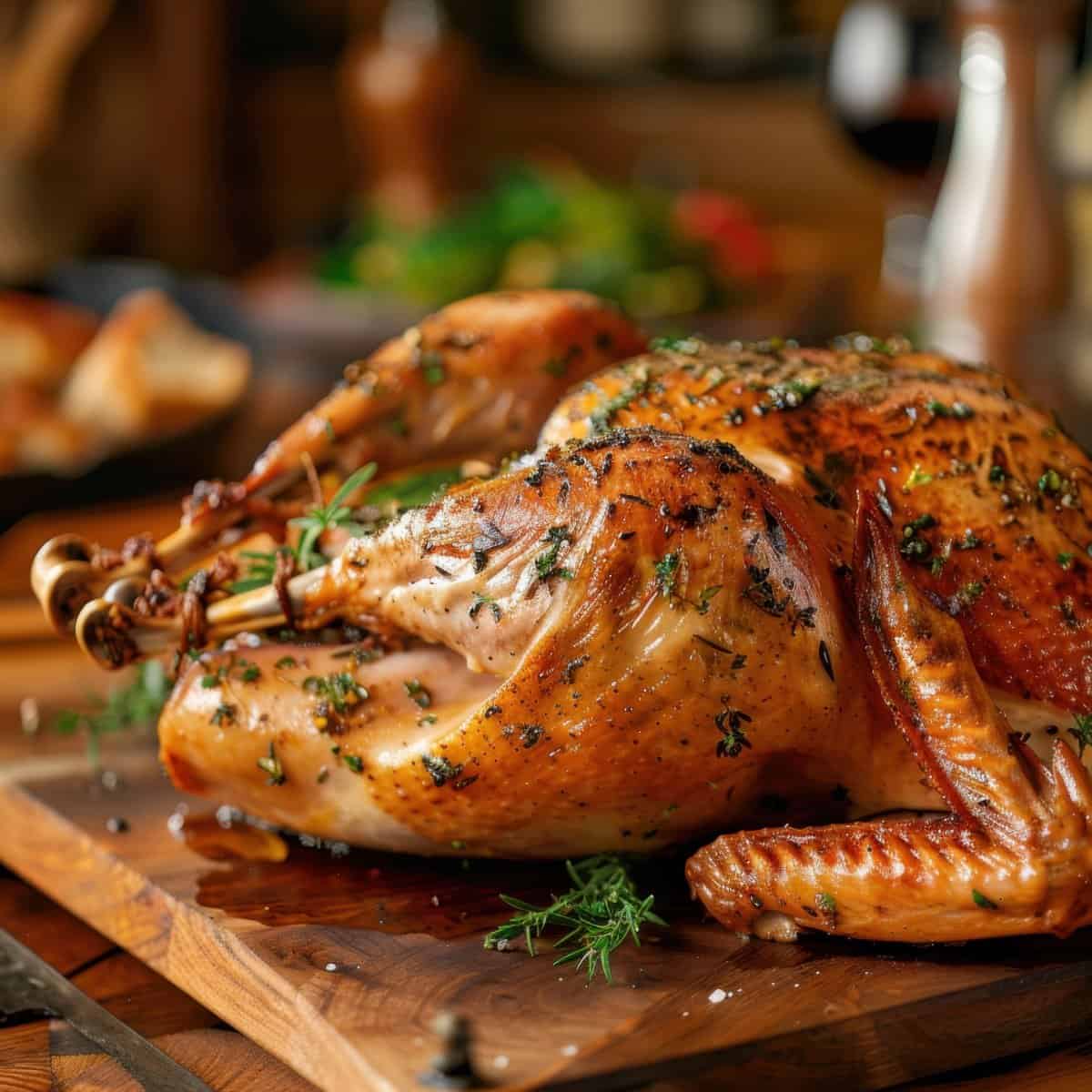

Spatchcock Chicken
Ingredients

Equipment
Method
- Place the chicken breast-side down on a cutting board.
- Using sharp kitchen shears, cut along both sides of the backbone from tail to neck.
- Remove the backbone.
- Flip the chicken breast-side up.
- Press down firmly on the breastbone with both hands until you hear it crack and the chicken lays flat.
- Tuck the wing tips behind the shoulders.
- Pat the chicken completely dry with paper towels.
- Combine kosher salt, brown sugar, black pepper, garlic powder, onion powder, and smoked paprika in a small bowl.
- Carefully lift the skin over the breasts and thighs.
- Apply about 60% of the dry brine directly on the meat under the skin.
- Apply the remaining 40% over the skin.
- Place the spatchcocked chicken skin-side up on a wire rack over a sheet pan.
- Refrigerate uncovered for 24-48 hours.
- Preheat oven to 450°F.
- Place the chicken skin-side up on a wire rack over a sheet pan.
- Roast for 40-50 minutes until the breast reaches 160°F and the thighs reach 175°F.
- Remove from oven and let rest for 15 minutes.
Notes
Tried this recipe?
Let us know how it was!Why Batch Spatchcock Chicken
It's Tuesday night. You're tired. You want actual roasted chicken for dinner-crispy skin, juicy meat, something that feels like a real meal-but you're staring down 90 minutes of roasting time plus all the prep. Except you're not, because you open your freezer and pull out a vacuum-sealed portion of spatchcock chicken you prepared three weeks ago. Reheat it while rice cooks or greens wilt, and you've got restaurant-quality roast chicken on the table in 20 minutes. No compromise, no takeout, no standing at the stove for an hour. This is exactly why you invested that Sunday afternoon.
Spatchcocking is the single biggest upgrade to roasting whole chickens. The dry brine makes the chicken delicious-salt overnight pulls moisture to the surface, and when that evaporates in the oven, you get shatteringly crispy skin. Spreading the bird out flat by cutting the backbone out makes the cooking go so much faster. You're not wrestling with uneven cooking anymore-every piece of skin faces up and gets direct heat, so it all crisps perfectly. No more flabby thigh skin while the breast dries out. Do two birds at once, portion them when they're done, vacuum seal, and you've just solved four dinners over the next month.
The Restaurant Method
Spatchcocking sounds intimidating, but it's a basic butchery technique that takes about two minutes once you've done it once. Kitchen shears along both sides of the backbone, press the bird flat with your palm until you hear the breastbone crack, and you're done. Save those backbones in a freezer bag-collect three or four and you've got free chicken stock.
The real magic is the dry brine. Season the birds with salt the night before if you can. That overnight rest pulls moisture to the surface, and when that moisture evaporates in the oven, you get the kind of crispy skin that makes people think you went to culinary school. It's the same technique restaurants use for roast chicken and duck-time does the work, not effort.
What Makes This Worth the Time
Whole chickens are cheaper per pound than any other cut, and spatchcocking means you're not fighting physics to get even cooking. Roast on a sheet pan with a wire rack so air circulates underneath-or skip the rack and use thick-cut onion rounds as a natural roasting rack that doubles as a side dish. Pull the bird at 165°F in the thickest part of the thigh, rest it 10 minutes, then carve. You're doing two birds at once, so your active time barely increases but your yield doubles. That's restaurant efficiency adapted for home-cook once, portion strategically, and have it vacuum sealed so you can pull it out whenever you want it.
Time Investment & Meal Yield
Here's the honest math on what you're building when you batch spatchcock chickens:
What You're Actually Building
- Active prep: 30 minutes hands-on (spatchcocking two birds, seasoning, setting up sheet pans)
- Passive cooking: 45 minutes in the oven (you're doing other things, maybe prepping a second batch component)
- Portioning & sealing: 20 minutes (carving, bagging by portion, vacuum sealing, labeling)
- Result: 4 portions = 4 complete dinners over the next 4-6 weeks
The Real-World Timeline
You cook on Sunday. Tuesday next week, you reheat one portion with roasted vegetables. Two weeks later, you shred another portion for chicken tacos. A week after that, you slice cold chicken for grain bowls. Four weeks out, you reheat the last portion for chicken and rice. One afternoon of work, four different meals across a month. The value spreads out over weeks, and every time you pull a portion from the freezer instead of ordering delivery, you're reclaiming both time and money.
Storage & The Freezer Reality
People hesitate at "frozen for weeks," but let's be honest about commercial frozen food. That frozen pizza in the grocery freezer? It sat in the manufacturer's freezer for weeks, the distributor's freezer for weeks, the grocer's freezer for weeks, and it's expected to sit in your freezer for months. Your vacuum-sealed spatchcock chicken is fresher than that pizza, fresher than most "fresh" prepared foods at the grocery store, and higher quality than anything you'd get from a drive-through.
Why Vacuum Sealing Changes Everything
- Flat storage: Bags stack efficiently in your freezer-no more freezer Tetris with round containers
- Fast thawing: Thaw overnight in the fridge, or reheat from frozen the same night in a 350°F oven
- Zero freezer burn: Properly vacuum-sealed whole chicken has a 3-6 month freezer life and tastes fresh when reheated
- Professional standard: This is how restaurants store prep for service-you're using the same method
The Commercial Food Comparison
Frozen chicken dinners from the grocery store have been in the supply chain for months. Your batch component goes from your oven to your freezer in under two hours, vacuum-sealed at peak freshness. When you reheat it four weeks later, it's still higher quality than anything you'd buy pre-made. You're operating with restaurant-grade storage methods, and the result is restaurant-grade quality.
Cost Breakdown
Let's calculate the actual cost of batch spatchcock chicken using realistic bulk pricing and compare it to what you'd pay for equivalent meals.
Batch Cost Calculation
Ingredients breakdown:
- Whole chickens: 2 birds × 5 lbs each × $1.49/lb = $14.90
- Seasonings (salt, pepper, oil): $1.00
- Total batch cost: $15.90
- Portions created: 4 (approximately 2.5 lbs cooked chicken per bird, divided into 4 meal portions)
- Cost per portion: $15.90 ÷ 4 = $3.98
The Savings Add Up
Per-meal comparison:
- Homemade portion: $3.98
- Rotisserie chicken from grocery store: $7.99 (and it's already been sitting under heat lamps)
- Restaurant roast chicken dinner: $14-18
- Savings per meal vs. restaurant: $16.00 - $3.98 = $12.02
- Total batch savings: $12.02 × 4 portions = $48.08
You're spending $15.90 and getting four high-quality roast chicken dinners that would cost $56-72 at a restaurant. Even compared to grocery store rotisserie chicken at $7.99 each, you're saving $16 on the batch while maintaining complete control over seasoning and quality. Plus your chicken hasn't been sitting under a heat lamp for hours.
Using This Component
Spatchcock chicken is one of the most versatile batch components you can stock. Reheat it whole for a classic dinner, shred it for tacos or salads, or slice it cold for grain bowls and sandwiches.
Quick Assembly Meals
- Classic Roast Chicken Dinner: Thaw overnight in fridge, reheat covered at 350°F for 20 minutes while you roast vegetables or cook rice-complete dinner in 25 minutes
- Chicken Tacos: Reheat and shred the meat, warm tortillas, add salsa and cilantro-dinner in 15 minutes
- Chicken and Rice Bowls: Slice cold chicken over rice, add Quick-Pickled Vegetables and a fried egg, drizzle with soy sauce-lunch or dinner in 10 minutes
- Chicken Caesar Salad: Slice cold chicken over romaine, add croutons and parmesan-no reheating needed, dinner in 5 minutes
This is how you stock a professional kitchen at home. You're not spending every night cooking from scratch-you're reheating high-quality components you prepared when you had time and energy. One Sunday afternoon, four Tuesday nights solved. Your freezer becomes the most valuable real estate in your kitchen.
Recipe
Spatchcock Chicken
Ingredients
Equipment
Method
- Place the chicken breast-side down on a cutting board.
- Using sharp kitchen shears, cut along both sides of the backbone from tail to neck.
- Remove the backbone.
- Flip the chicken breast-side up.
- Press down firmly on the breastbone with both hands until you hear it crack and the chicken lays flat.
- Tuck the wing tips behind the shoulders.
- Pat the chicken completely dry with paper towels.
- Combine kosher salt, brown sugar, black pepper, garlic powder, onion powder, and smoked paprika in a small bowl.
- Carefully lift the skin over the breasts and thighs.
- Apply about 60% of the dry brine directly on the meat under the skin.
- Apply the remaining 40% over the skin.
- Place the spatchcocked chicken skin-side up on a wire rack over a sheet pan.
- Refrigerate uncovered for 24-48 hours.
- Preheat oven to 450°F.
- Place the chicken skin-side up on a wire rack over a sheet pan.
- Roast for 40-50 minutes until the breast reaches 160°F and the thighs reach 175°F.
- Remove from oven and let rest for 15 minutes.



Was this helpful?
You must be logged in to post a comment.